What Is a Silent Switch? Quiet Keyboard Switches Explained
Explore how a silent switch reduces impact noise, compare damping designs, and choose quiet linear or tactile switches by feel, sound, and value.
What is a silent switch?
A silent switch is a keyboard switch designed to reduce the impact noise made as its moving parts reach their stops. Cushioning can soften the landing at the bottom of a press, the return at the top, or both. The name describes a quieter mechanical action; it does not mean that a complete keyboard produces no sound.
That distinction matters when choosing a silent switch. A soft landing, a firm landing, a light stroke and a pronounced tactile bump are different qualities. Quiet switches do not all feel alike, and a design that suits shared-office typing can still feel too soft or too heavy for another person.
This guide uses the construction and feature comparisons below to explain those choices. Their categories are practical descriptions of the pictured examples. Product design, spring, keycap and keyboard build remain important when comparing the result.
A silent switch changes the impacts you hear and feel
Bottom-out is the contact at the end of downward travel. Top-out is the contact when the stem returns to its resting position. A silent switch can treat these two events differently, so press slowly, pause, and release when comparing samples. The keyboard switch sound guide explains how to distinguish them from spring ping and scratch during travel.
Adding a cushion also changes the landing sensation. Some designs feel soft or squishy; others keep a more defined stop. The shape and position of the damping parts matter alongside their material and the force used to type. A quieter impact does not automatically imply a weaker tactile bump or slower return.
The rest of the board still contributes. Stabilizers, keycaps, the plate and case can remain audible after a switch change. Listen to an ordinary key and a stabilized key separately, and compare switches in the same build before committing to a full set.
Bottom-out
Press the key all the way down
Top-out
Release the key and let it return
Four silent switch damping designs to compare
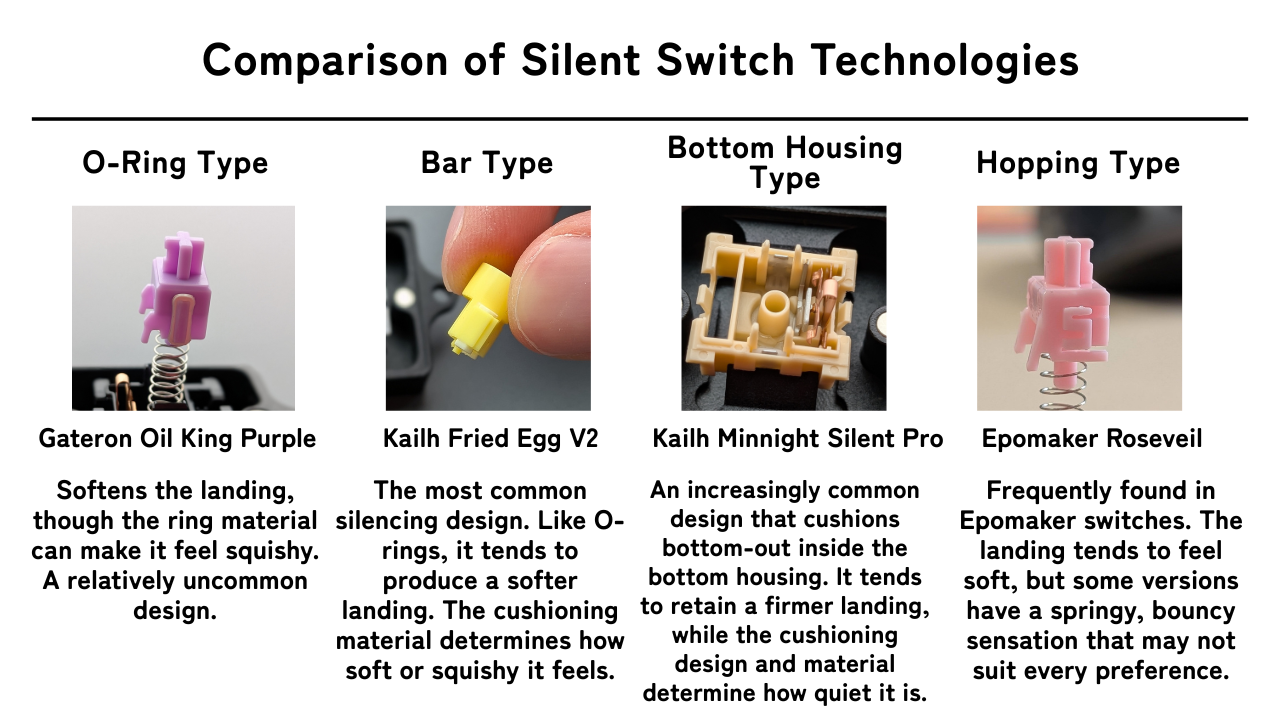
The first comparison groups silent switch examples by the visible arrangement of their damping parts. These labels help explain construction; they are not standardized switch categories with a guaranteed sound or feel. In particular, the chart's claims about how common each design is should be read as part of that comparison rather than a market survey.
| Design | What it describes | Example and comparison point |
|---|---|---|
| O-ring / stem-rail ring | Small internal rings cushion contacts around the moving stem rails. | Gateron Oil King Purple: compare the cushioning on both the press and return. |
| Bar-shaped cushioning | The comparison shows elongated cushioning associated with the stem. | Kailh Fried Egg V2: compare the softness and definition of the landing. |
| Housing-mounted damping | Damping inserts sit in the housing and interact with the moving stem. | Kailh Midnight Pro Silent: the maker shows pads at the sides of the lower housing. |
| Hopping-style construction | The chart uses this label for a construction and springy-feel comparison. | Epomaker Roseveil Silent: sample the landing and return to decide whether that sensation suits you. |
The photographs illustrate the illustrated classification. Pad placement, material and feel must be checked for the exact product revision.
Stem rings and bars can soften the landing
Gateron Oil King Purple illustrates an internal ring arrangement. Its supplier describes mute rings around the stem rails for top-out and bottom-out. These are parts inside the switch, distinct from aftermarket O-rings fitted under keycaps. Purple is a silent tactile variant; the original Oil King linear is a different product.
The bar category uses Kailh Fried Egg V2 as its pictured example. The useful question is how the cushion compresses and how clearly the end of travel is defined. The chart describes a softer landing, with the exact sensation depending on the cushioning. The label alone does not identify its chemical composition or establish that every bar-style silent switch is equally soft.
Housing and hopping labels describe different details
Kailh Midnight Pro Silent is the housing-mounted example. Its official diagram shows muffler inserts at the sides of the lower housing. ‘Bottom Housing Type’ in the comparison therefore should not be taken to mean that the center pole always lands on a soft pad directly beneath it. The housing and stem work together to determine the stopping contact.
Epomaker Roseveil Silent is a silent linear example placed in the chart's hopping category. The chart highlights a soft, springy landing. Treat hopping as a descriptive label for this illustrated comparison, rather than a separate electrical switch technology or a feature shared by every Epomaker model. A small sample is the clearest way to judge whether the extra bounce is enjoyable.
Hybrid silent switch designs tune more than one contact
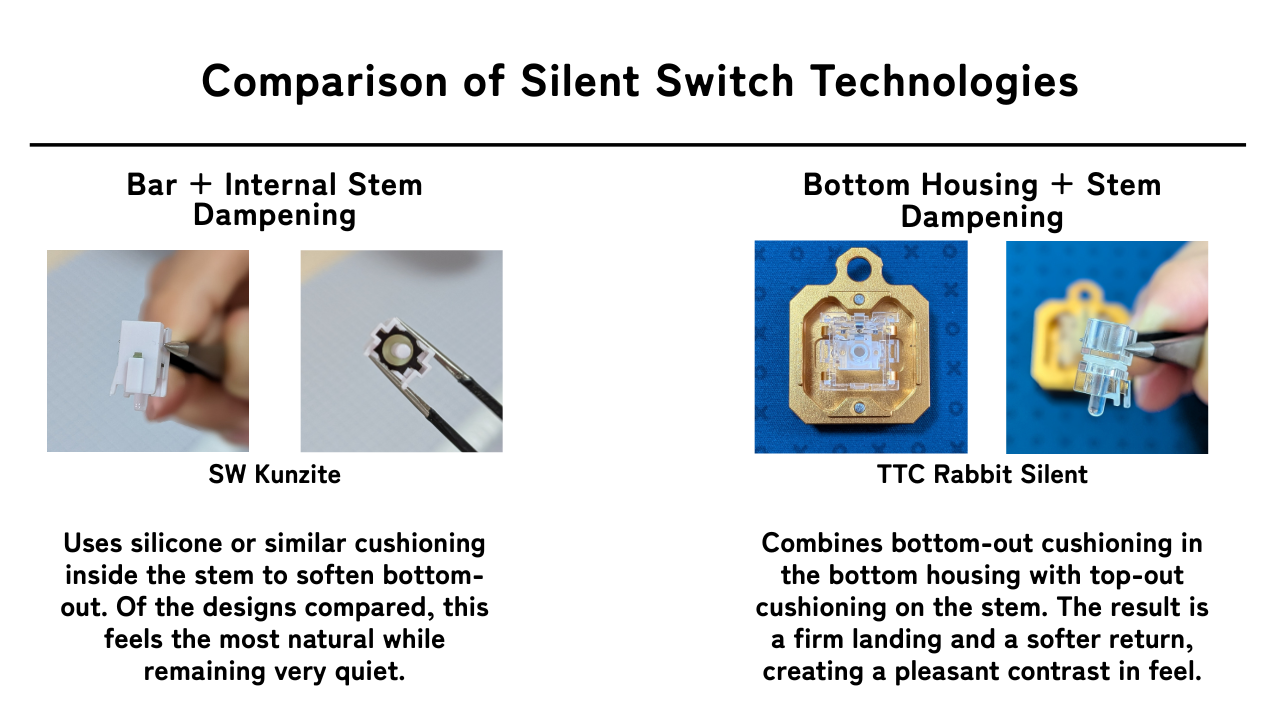
A silent switch can combine damping arrangements instead of relying on a single cushion. The second comparison groups SW Kunzite as bar plus internal-stem damping, and TTC Rabbit Silent as bottom-housing plus stem damping. The aim is to consider the downstroke and return as separate parts of the typing experience.
For SW Kunzite, the internal-stem grouping comes from the photographs and comparison. The exact product is sold as a silent linear. Its particularly natural-feeling, quiet action is the comparison's impression, rather than an independently measured result against every silent switch. The label also does not establish what material the internal element uses.
TTC documents a stem-associated square-ring silencer and a bottom muffler in Rabbit. The comparison describes a firmer landing paired with a softer return. That contrast is useful to listen and feel for, while recognizing that the sensation depends on the complete design. Check whether a listing refers to Rabbit OG or RGB when matching specifications and photographs.
Choose silent linear or silent tactile separately from damping
Linear and tactile describe the stroke, while silent describes the noise-reduction design. A silent linear switch has no deliberate tactile bump. A silent tactile switch adds a bump during movement and can still cushion the contacts at both ends. The linear switch guide and tactile switch guide cover those differences in more detail.
Spring weight is another choice. A quiet switch can still feel heavy to press, and a strong return can stand out even with a soft landing. Compare the complete force profile and reliable return rather than choosing from a single number. The keyboard switch spring guide explains how spring length, preload and force ratings relate.
Choose a silent switch by your main priority
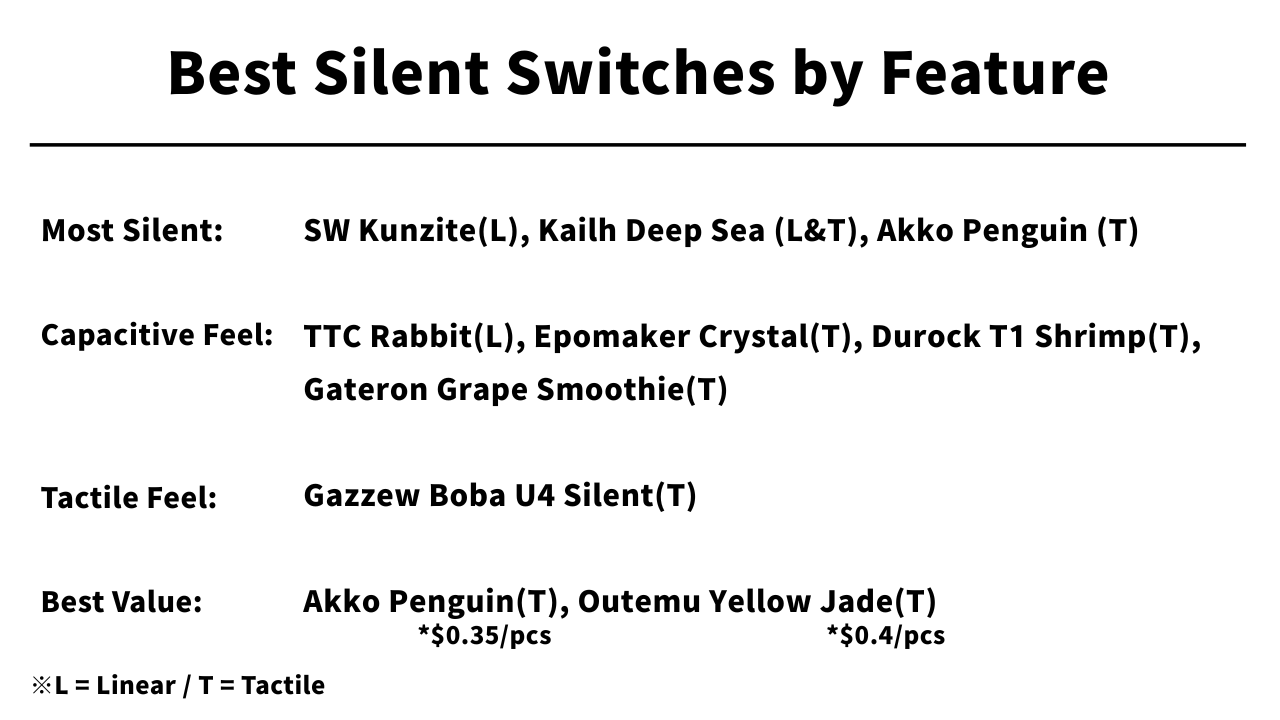
The feature comparison offers four ways to begin a shortlist. ‘Most Silent’ is best used as a quietness-focused set of candidates, and ‘Best Value’ as a budget-focused set. The models are not ordered by a common acoustic test, and a recording in one keyboard cannot establish how another build will sound.
| Priority | Examples to sample | What to compare |
|---|---|---|
| Quietness | SW Kunzite; Kailh Deep Sea Silent Pro Box Islet (linear); Kailh Deep Sea Silent Pro Box Whale (tactile); Akko Penguin Silent (tactile). | Both bottom-out and top-out, plus any spring or stabilizer noise. |
| Cushioned / capacitive-like feel | TTC Rabbit Silent (linear); Epomaker Crystal Silent Tactile; Durock T1 Shrimp; Gateron Grape Smoothie Silent Tactile. | Landing shape, return and bump. The phrase describes feel, not capacitive sensing. |
| Pronounced tactile feedback | Gazzew Boba U4 Silent (tactile). | Bump shape and resistance without assuming that silencing removes tactile feedback. |
| Value | Akko Penguin Silent and Outemu Silent Yellow Jade (both tactile). | Current pack price, quantity, shipping and taxes alongside feel and fit. |
The Deep Sea examples here refer to the normal-profile Pro BOX Islet and Whale, rather than the separate Mini range. L and T in the image mean linear and tactile.
For a quietness-first silent switch
Start with SW Kunzite, the appropriate Kailh Deep Sea Silent Pro variant, or Akko Penguin Silent from the comparison. Decide whether a linear or tactile stroke is more comfortable before comparing the remaining noise. In the normal-profile Pro BOX range, Kailh Deep Sea Silent Pro Box Islet is linear and Kailh Deep Sea Silent Pro Box Whale is tactile.
Listen for the return as carefully as the landing. A soft downstroke can coexist with a more noticeable top-out, and the case can amplify a small sound. Keep the keyboard and typing force consistent when deciding which silent switch best suits a shared room.
For a cushioned, capacitive-like typing feel
The comparison groups TTC Rabbit Silent, Epomaker Crystal Silent Tactile, Durock T1 Shrimp and Gateron Grape Smoothie Silent Tactile by a cushioned or rounded typing impression. ‘Capacitive-like’ is a feel comparison. These mechanical switches do not become electrocapacitive switches, and the phrase says nothing about compatibility with an electrocapacitive keyboard.
Durock T1 Shrimp is the first listening example below. It is a silent tactile switch; the creator describes its bump and spring resistance as part of a Topre-like impression. Rabbit is linear, so the other examples in this group do not all produce the same sensation. Compare the landing, return and bump individually.
The recording uses a QR65 R1, SA-P keycaps, gasket mounting and all foam installed. It is a complete keyboard reference, so take its character as a listening aid rather than an isolated measurement of the switch.
For pronounced tactile feedback in a silent switch
Gazzew Boba U4 Silent is the comparison's tactile-focused candidate. Its supplier describes a pronounced D-shaped bump alongside the silenced action. This is a useful starting point when clear feedback matters as much as a quiet landing.
Check the exact U4 revision and spring option. U4T is a different product and should not be substituted for the silent U4 because the names look similar. Sample the bump and the force needed to move through it; a strong tactile sensation and a soft end stop can be present together.
For a silent switch with good value
Akko Penguin Silent and Outemu Silent Yellow Jade are the comparison's budget candidates. Both are silent tactile examples. A lower price is useful only if the stroke, mounting and sound suit the keyboard you intend to build.
The chart's $0.35 and $0.40 figures are indicative comparison prices, not current quotes. Compare the pack total, number of switches, shipping and applicable taxes at the time of purchase. Buying a few samples before a full set can also be better value than replacing a set whose feel is uncomfortable.
Make the final choice in the keyboard you will use
A useful silent switch comparison changes one variable at a time. Use the same keycap and board, compare an ordinary key before a stabilized one, and keep playback volume consistent when listening to recordings. A microphone, room and keyboard build can alter the impression as much as the choice of switch.
Choose the balance you enjoy: a softer or firmer landing, a gentler or stronger bump, and a return that feels comfortable. The charts and listening sections make that comparison easier to organize. A small set of well-chosen samples gives a clearer answer than treating silent as a single sound or feel.