Keyboard Switch Springs Explained: Length, Stages, and Gold Plating
Explore keyboard switch springs, from length and stage design to wire diameter and gold plating, and learn which details matter when choosing a spring.
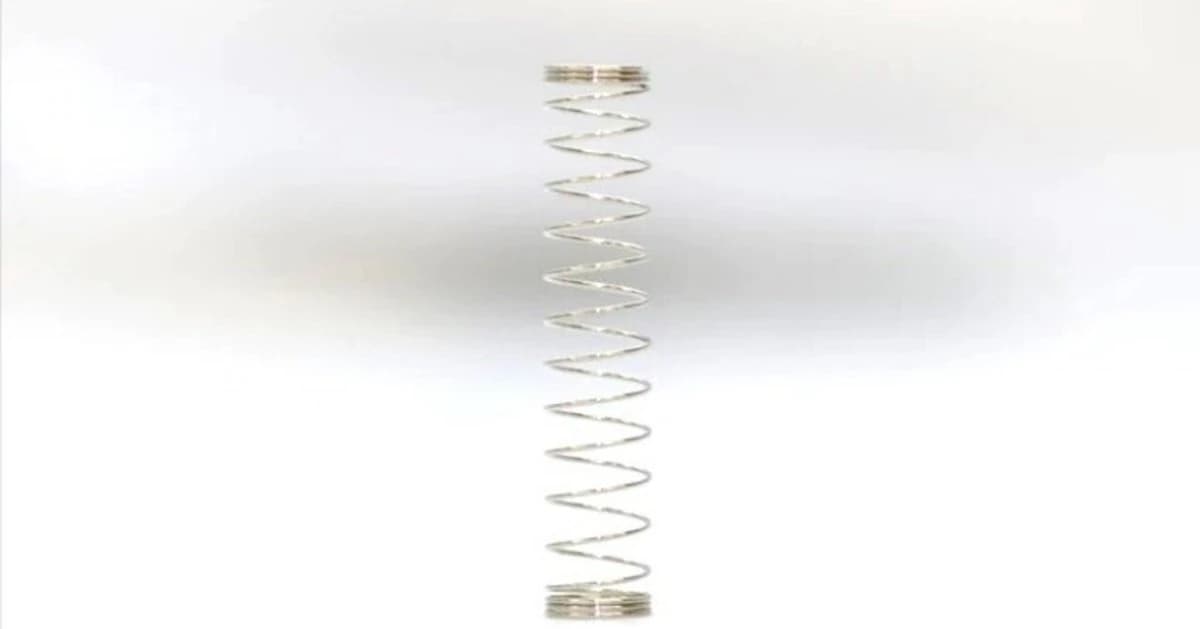
What does a keyboard switch spring do?
Choosing a replacement keyboard switch spring involves more than a weight rating. Free length, winding layout, wire diameter, and surface finish can all appear in product listings, but each describes a different part of the design.
The spring resists the downward movement of the stem and helps return the key after you release it. It is one part of the complete switch: stem and housing geometry, friction, lubrication, and any tactile mechanism also shape the result. The linear switch guide and tactile switch guide explain those other parts in more detail.
This guide explains how to read those specifications and compare springs in the same switch, with practical checks for force, fit, and return.
Read the force rating before comparing spring length
A label such as 55g needs context. In keyboard listings, g commonly means gram-force, but the number can describe different points in the stroke. Starting force is the resistance at the key’s resting position; operating force is associated with electrical registration; bottom-out force is measured at the end of the intended travel. Check which point the seller uses.
Two springs can share a bottom-out rating while feeling different near the top. SPRiT’s listings illustrate this by distinguishing starting-force variants within the same nominal weight family. A single number therefore cannot describe everything your finger experiences through a press.
Spring rate describes how much the spring’s force changes with compression. A roughly linear spring has a roughly constant rate, so its force rises through the stroke. Constant rate does not mean constant force, and a spring’s force curve is only one contribution to the complete switch’s force curve.
Single-stage, two-stage, and three-stage springs
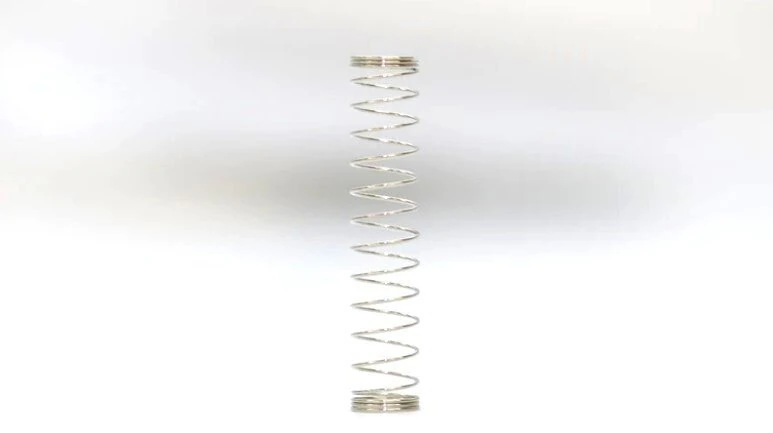
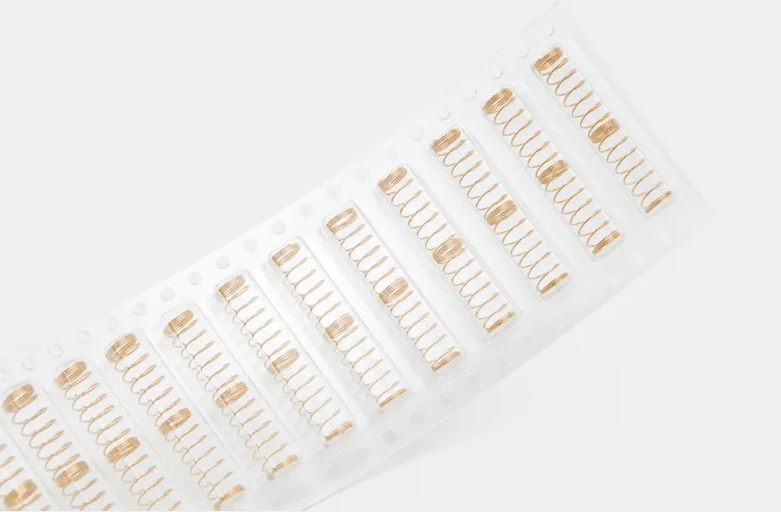
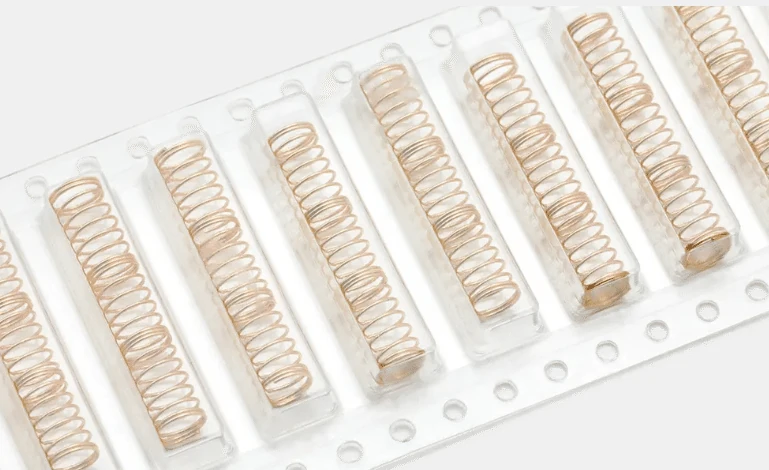
Stage labels usually describe the visible layout of the winding. A common single-stage spring has one open-coiled section between its ends. Two-stage and three-stage designs add closely wound bands that visually divide the spring into sections. They are still one continuous piece of wire.
The photographs below illustrate common winding layouts. They show construction examples; a force curve is needed to compare how each spring behaves inside a switch.
Stage count alone does not tell you that a keypress will have two or three distinct changes in resistance. The working coils and the rest of the design determine the response. Read the maker’s force information for the exact model: SPRiT, for example, publishes starting-force distinctions for its Multi-Stage family instead of relying on the name alone.
How progressive springs relate to stage count
Progressive describes a changing rate of force increase through compression. A variable-pitch design can produce that behavior as some coils become inactive, but the response depends on the actual design and the range of compression used in the switch. A photograph or a stage label is not a substitute for a force curve.
For a useful comparison, try stage designs with similar stated force ratings in the same switch model. Check both the press and the return, then choose the force profile that feels comfortable in use.
What changes when a switch spring is longer?
Free length is the spring’s length outside the switch, with no load applied. Once the switch is assembled, the spring is already compressed. That initial compression is called preload, and it helps explain why free length can matter before the key has moved at all.
With other relevant dimensions held comparable, fitting a longer free spring into the same space increases its initial compression. If two designs are also tuned for the same bottom-out force, the one with more starting resistance can have a smaller rise in force over the stroke. That more even-feeling resistance and firmer return near the top are reasons to try longer spring designs. Free length by itself does not specify the entire result.
Swagkeys SW Springs provide a concrete example of the range of lengths on a listing. The same product family includes Classic at 14.5 mm, Chewy at 17.5 mm, Progressive at 16.5 mm, and Chewy Long at 20 mm. These labels identify different designs; they are not a controlled experiment in which only length changes.
Spring length and switch travel are different measurements
Swapping a conventional mechanical switch’s return spring does not, by itself, move the electrical contact geometry or the normal bottom-out stops. A longer spring therefore does not automatically mean a longer actuation distance, and a shorter spring does not automatically make a key register earlier.
A spring can change the effort and return sensation, which may affect how quickly you choose to press or release the key. That is different from changing the switch’s specified travel. Fit still matters: a spring that runs out of compression space can interfere with the intended stroke, so check that a sample moves through its full travel and returns properly.
Gold-plated springs and stainless steel springs
Gold plating describes a surface finish; stainless steel describes a base material. They are different kinds of specification. A plated spring still has a base wire whose dimensions and material help determine its mechanical response. The gold color alone does not tell you the starting force, rate, or manufacturing consistency.
Surface treatments can serve appearance, corrosion protection, or other engineering purposes. Whether a particular coating improves durability depends on the base material, coating quality, thickness, and environment. It is too broad to assume that every gold-plated keyboard spring will outlast every stainless steel one.
Gold’s electrical conductivity is also not a reason to expect faster registration from an ordinary MX-style return spring. Its job here is mechanical; electrical switching takes place at the contact assembly. Choose the spring for its force characteristics and compatibility.
A gold-colored spring can be an aesthetic choice in a transparent switch housing. Compare its force characteristics and fit separately from its appearance.
Wire thickness, coil diameter, and typing feel
Wire diameter means the thickness of the wire itself. Coil diameter means the width of the spring’s coiled body. They are separate dimensions, and both matter alongside the number of active coils and the wire material.
For a conventional round-wire compression spring, increasing wire diameter raises the rate when the other relevant variables are held constant. Increasing the mean coil diameter or the active coil count lowers it. This is why judging a spring by one visible dimension can be misleading.
If two springs have the same length and nominal force rating but different wire thicknesses, other design details may compensate for that difference. You cannot conclude that the thicker-looking one must feel heavier throughout its stroke. Compare the force profile and the assembled switch.
Sound and comfort also deserve a direct comparison. Spring noise, top-out, bottom-out, keycaps, and the keyboard all contribute to what you hear. Wire thickness alone cannot promise a louder, quieter, sharper, or softer sound, and neither a stage count nor a finish guarantees comfortable typing.
How to choose keyboard switch springs
Start with the part of the stroke you want to change. A key that feels too demanding at the start calls for a different comparison from one that feels fine at the top but too heavy at bottom-out. Then narrow the options by force information and fit before considering stage names or finish.
- Keep an unchanged switch as a reference and start with a few samples.
- Use the same switch model, keycap, and key position where practical so the spring comparison is easier to interpret.
- Try the starting resistance, the full press, and the return before deciding on a complete set.
- Record the exact length, force reference, model, and treatment you preferred, so you can reproduce the result.
| Your question | Useful specification or check | How to compare |
|---|---|---|
| Does the beginning of the press feel right? | Starting force and assembled preload. | Compare the initial resistance in the same switch. |
| How does resistance build? | Force curve and spring rate. | Read the maker’s description for the exact design. |
| Is the end of the stroke comfortable? | Bottom-out force at the stated compression or switch travel. | Confirm that the seller’s force numbers use the same reference point. |
| Will it fit and return properly? | Length, coil diameter, compression space, and switch compatibility. | Check a small sample through full travel before modifying a set. |
| Do the sound and appearance suit the build? | Noise in the actual build, lubricant treatment, and visible finish. | Use the same keycap and keyboard; choose appearance according to taste. |
Where to buy keyboard switch springs
Replacement keyboard switch springs can be compared at the following stores. Check the length, force-rating reference, and switch compatibility on the specific listing when choosing an option.