GMK Keycaps Guide: CYL vs. MTNU, Special Finishes, and Which Kit to Buy
Compare GMK CYL and MTNU, see how metallic and glitter finishes change from set to set, and work out exactly which keycap kit fits your keyboard.
1. What are GMK keycaps?
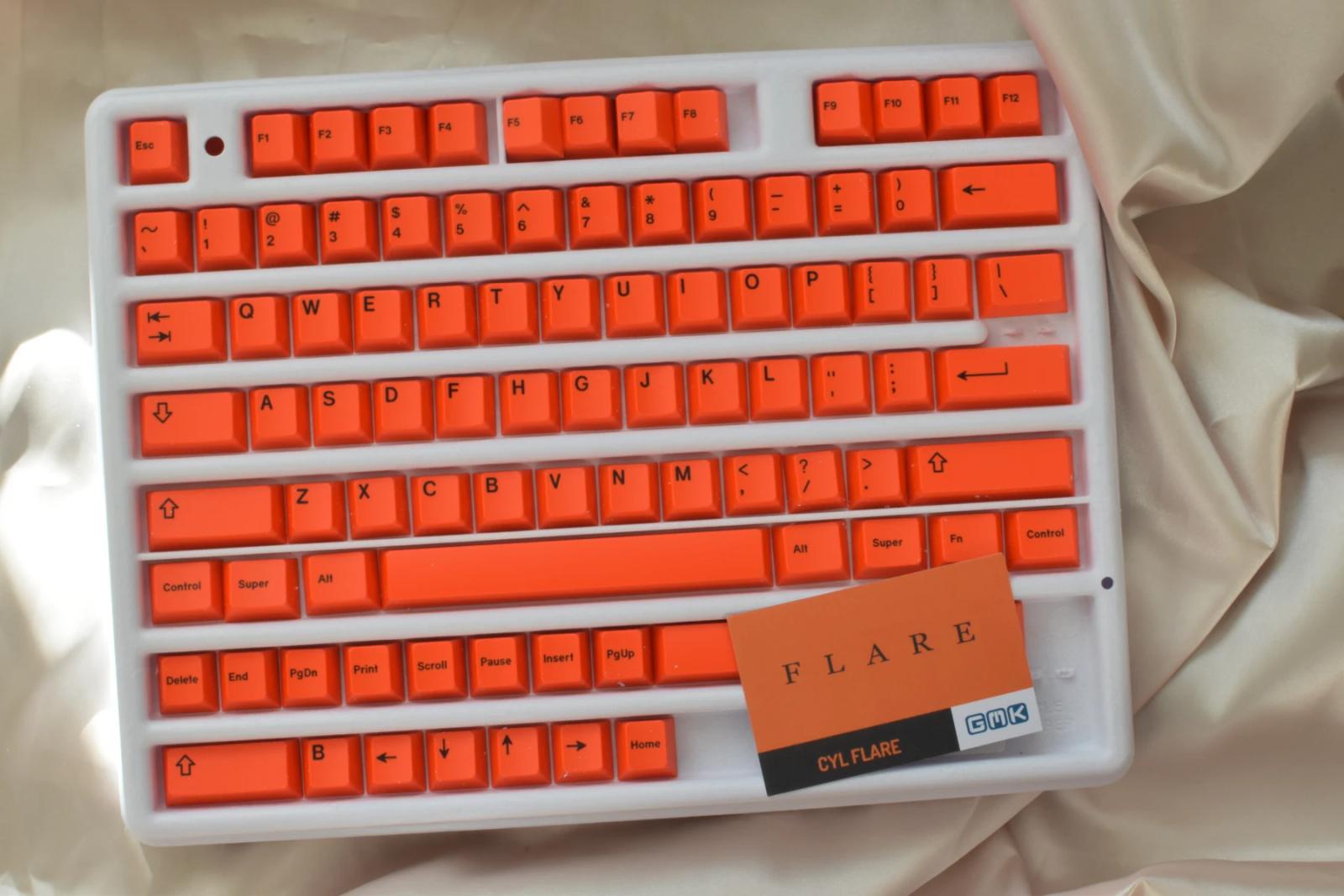
GMK electronic design manufactures keycaps in Germany for mechanical keyboards. A listing might say GMK CYL White on Black or GMK MTNU White on Black. GMK identifies the manufacturer, CYL or MTNU identifies the profile, and White on Black identifies the colorway. The selected kit tells you what arrives in the box. Those four pieces of information matter more to a buyer than the GMK name by itself.
Most of the sets discussed here use doubleshot molding. Two shots of plastic form the body and legend of a keycap. The letter or symbol you see is a piece of the molded cap, so wearing down the fine texture on the surface leaves the molded legend in place. Some designs also use UV printing for additional colors or details. If the set has an elaborate novelty or a second line of text, check how that particular detail was made.
A colorway can contain a base kit, a set of novelties with decorative symbols, and smaller kits for spacebars, a numpad, or localized legends. Two vendors may sell the same colorway with the same photograph while the selected options contain entirely different keys. Look for the kit name beside the price and remember it when you compare stores.
For a first build, settle three questions in order. Decide how you want the tops of the keys to feel, check the physical layout and legends you use, then work out which colors or effects you care about. Choosing a kit by the keyboard in the hero photo skips the second question. One fully assembled board can show an accessory kit mixed into the base, and even boards of the same size can use different spacebars or Shift keys.
2. GMK CYL vs. MTNU
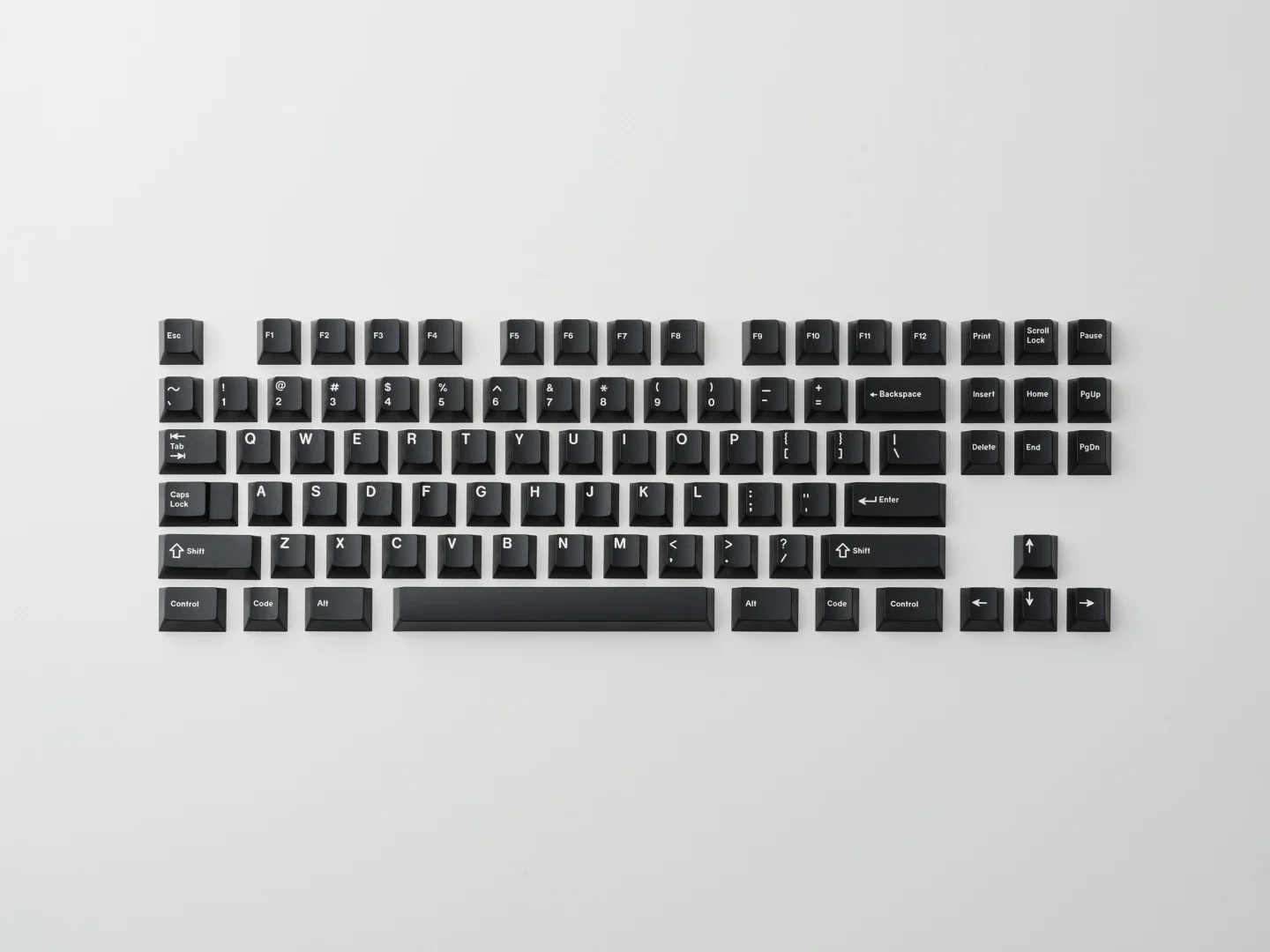
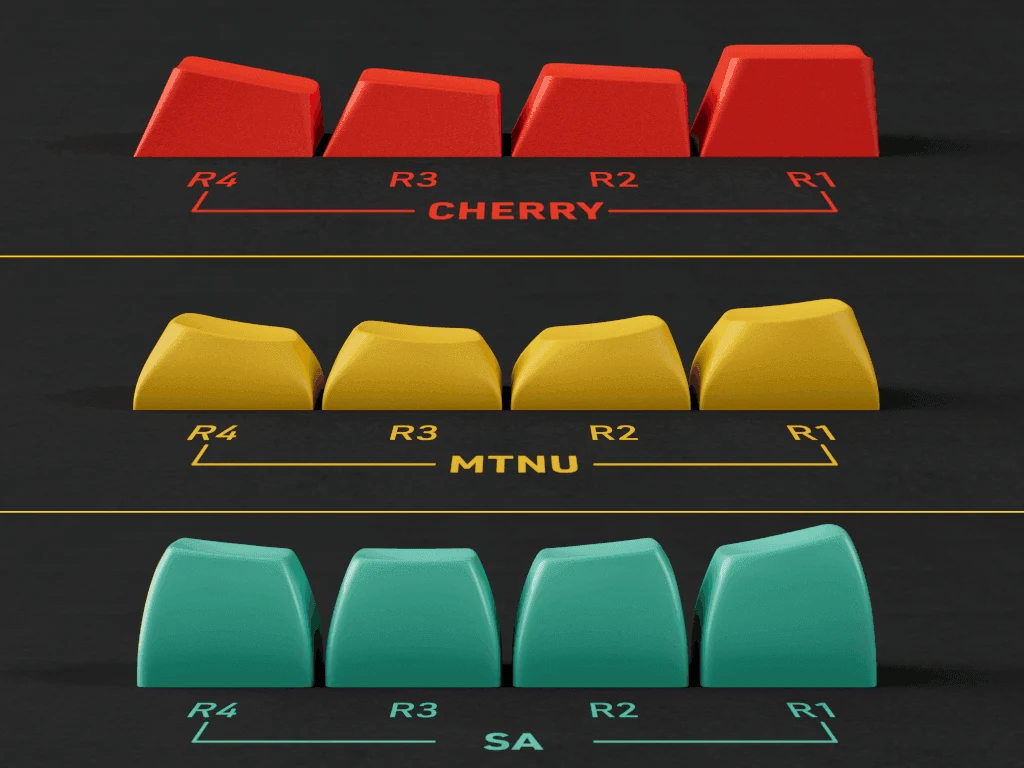
CYL is GMK’s Cherry-profile family. On an ordinary letter key, the top curves across the key from left to right in a shallow trough. The curve and angle give the fingertip a distinct landing area. GMK’s White on Black CYL set specifies 1.5 mm doubleshot ABS. GMK also uses the CYL family for the metallic, streaked, and particle-filled examples in this guide.
MTNU is a medium-height sculpted profile designed by Matt3o with GMK. Its top is dished in both directions, giving the letter keys a rounder surface. Matt3o describes its height as similar to Cherry profile while shaping the tops and row angles differently. The homing keys are deeper dishes in the design notes, an especially useful detail to check if you locate F and J by feel and are accustomed to a raised bar. GMK makes the MTNU White on Black set in doubleshot PBT.
Both profiles change shape by row. On the White on Black versions covered here, GMK labels the rows R1–R1–R2–R3–R4–R4 from the function row down. That gives an R1 number-row key and an R3 home-row key different jobs even if both are 1u. Keep the row labels printed on the GMK kit diagram. A keyboard maker may number its rows from the other end, so the safest way to match two diagrams is by physical position and width.
| What to compare | CYL White on Black | MTNU White on Black |
|---|---|---|
| Profile | Cherry profile, with cylindrical tops on the letter keys | Medium-height sculpt with round, spherical tops on the letter keys |
| Construction | Doubleshot ABS | Doubleshot PBT |
| Row sculpt | R1–R1–R2–R3–R4–R4 in this set | R1–R1–R2–R3–R4–R4 in this set |
| Example kit | 70% Base has 89 caps | 70% Base has 90 caps |
Compare the diagrams for the profile you order. A shared colorway or kit name can still have different contents.
Decide by shape, then check the rest of the keyboard
The useful photo comparison is the same letter from the same row, shot from the front and side. An overhead shot shows the shape of the dish, while a low camera angle shows the height and slope. Comparing a CYL number key with an MTNU home-row key mixes up the profile and the sculpt. A spacebar is a poor stand-in for either family because its top is shaped for the thumbs.
Think about how you hit the edge of a key. A wider, rounder dish changes where the pad of your finger comes to rest, while changing row angles can change how easily you move between the number and home rows. A board’s front height and tilt also affect how you reach those rows. If you can try a sample, mount more than a single letter key and type an ordinary line that takes your fingers across the board.
For a uniform set, carry the profile choice through to every kit you add. A CYL UK Kit belongs with CYL White on Black, and the corresponding MTNU UK Kit belongs with MTNU. Even where a mismatched cap mounts, it can interrupt the height of the row. The same check is useful when buying replacement keys, especially an Enter or spacebar sold without the box label.
3. Metallic, glitter, and other GMK keycap finishes
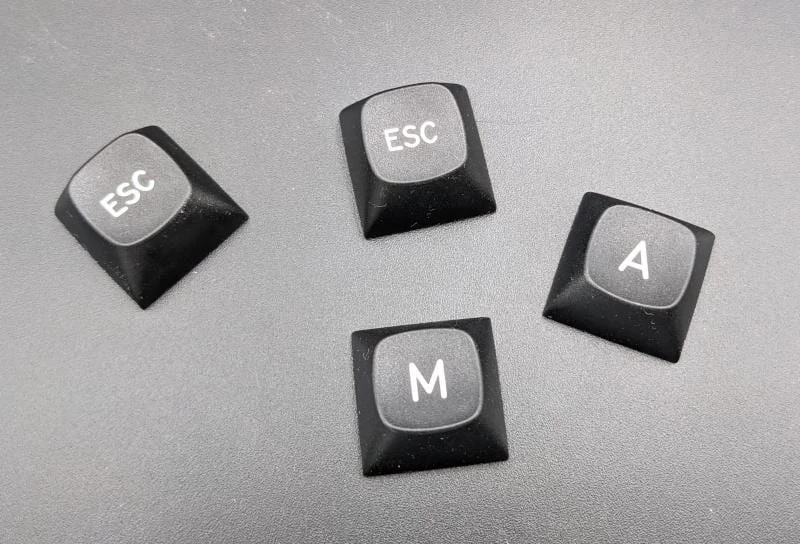
GMK uses special material mixes for effects such as a metallic sheen, small flecks, or colored streaks. The first thing to ask is where the effect lives. It could occupy the tiny strokes of a legend, the entire body of a spacebar, a strip of digits, or most of the board. Look at the kit sheet to see which keys carry it, then look at a sample photograph to see what the material does with light.
| Set | Placement | Detail to inspect |
|---|---|---|
| Black & Gold | Metallic gold legends and selected accents | Compare a gold letter on black with the larger gold surface of an accent. |
| Kaiju Part Deux — Mechakaiju | Metallic ABS in the body of the caps | Compare several key faces for variation in molding flow. |
| Purple | Metallic gray legends and reversed extra Esc and Enter | Check the subdued gray on purple and the accent treatment separately. |
| Thunder God | Doubleshot sparkle on the accent number row | Look at the physical sample in more than one lighting setup. |
| Flitter Effect Accent Kits | Flecks on Esc, Enter, and spacebar accents | Check the color variant and which of the five keys fit your board. |
Metallic ABS in Black & Gold, Mechakaiju, and Purple
Bobatype’s GMK CYL Black & Gold uses metallic ABS mainly for the gold legends, with selected accents putting the gold across a larger area. On a black letter key, the effect is confined to the letter. An accent can show a much wider patch of the same treatment. If you like the look of a subtle gold inscription but want the keyboard to read as mostly black at desk distance, the base and accent choices let you tune how much gold you actually see. The Art Deco and Casino Royale novelty kits are separate choices, as are the accent spacebars.
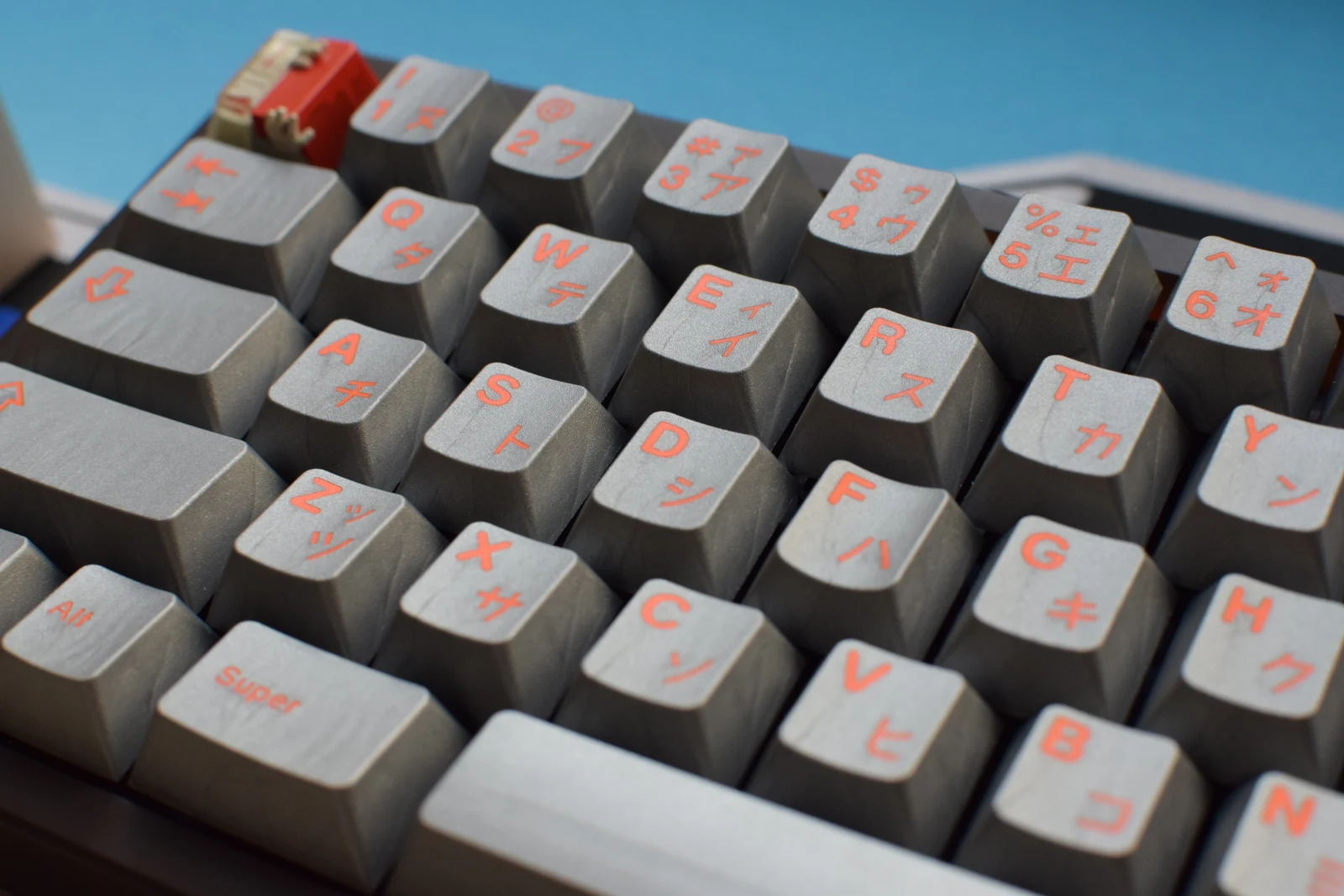
The Mechakaiju kit of NovelKeys’ GMK CYL Kaiju Part Deux gives the metallic material much more room. The effect is part of the keycap body, so it can show across full key faces. NovelKeys provides samples and describes how particles follow different flow patterns when the caps are molded. Two keys in the same kit can catch the light differently or show different lines. The samples are especially helpful here because a render can make neighboring key faces look more uniform than the molded pieces.
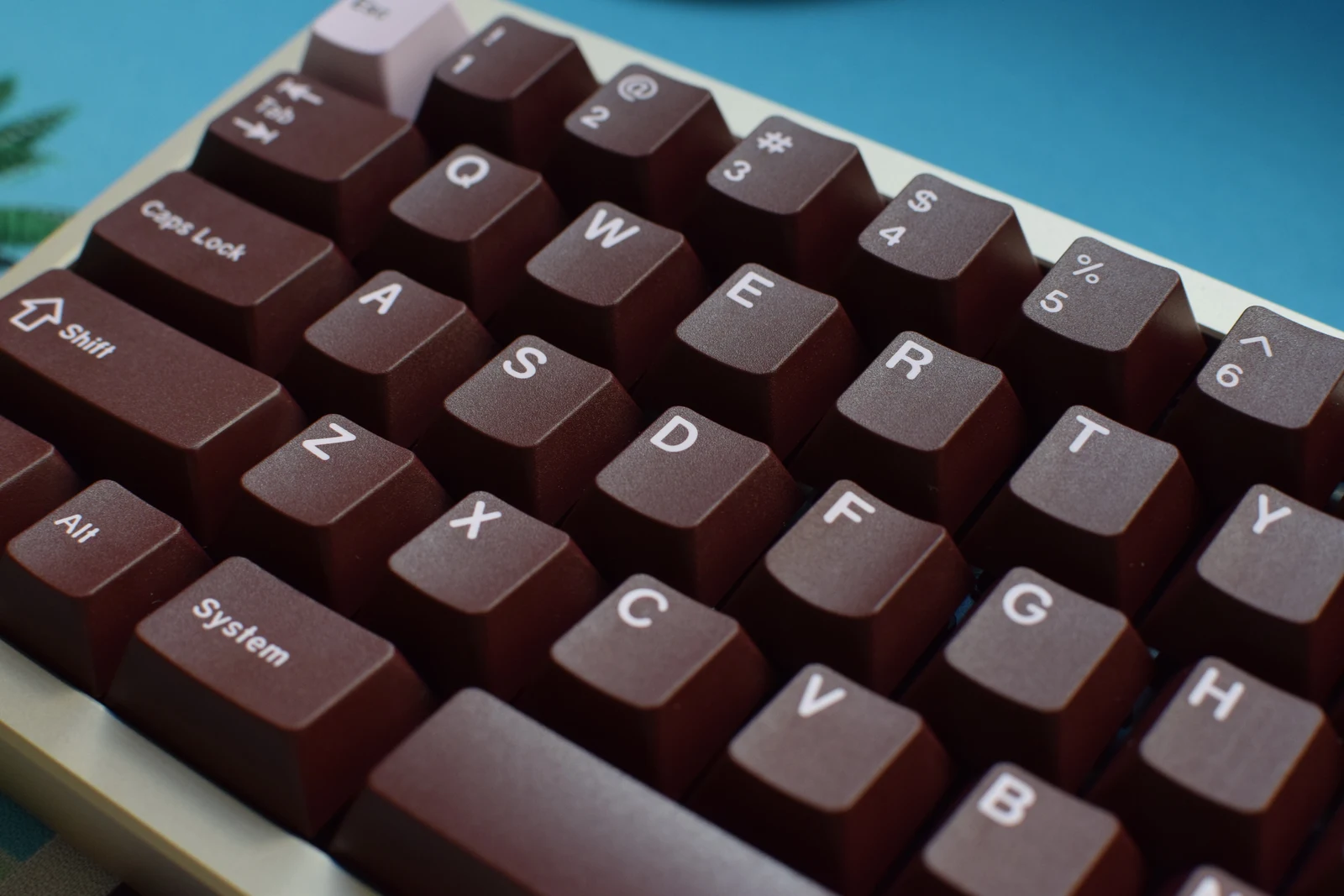
Compare the key faces in the two Keebpedia close-ups below. The deep red caps show the fine texture of standard ABS. On the silver-gray Mechakaiju caps, faint flow lines and a metallic sheen are visible across the key faces, especially on the wider keys.
GMK CYL Purple uses the effect at a different scale. GMK describes Khor’s design as a medium purple ground with metallic gray legends derived from Hi!Viz, reversing those colors on the extra Esc and Enter keys. Check both the regular keys and the accents in its material. A buyer drawn to the purple field may want just the quiet gray on the letter keys. Someone buying for the metallic effect may care more about the extra keys where gray occupies more space. GMK’s listing identifies the intended treatment, and physical production photos are the better reference for final appearance when they are available.
The product specification matters if you are after a metal cap. GMK’s MVKB × Salvun aluminum artisan is a separately sold, machined R1 1u key. It takes a single compatible position, such as a matching Esc position. Metallic ABS belongs to the molded plastic set. Compare both the placement and material if you want the accent to match a metal case, especially under a lamp that shows the case finish clearly.
Glitter in Thunder God and the Flitter Effect Accent Kits
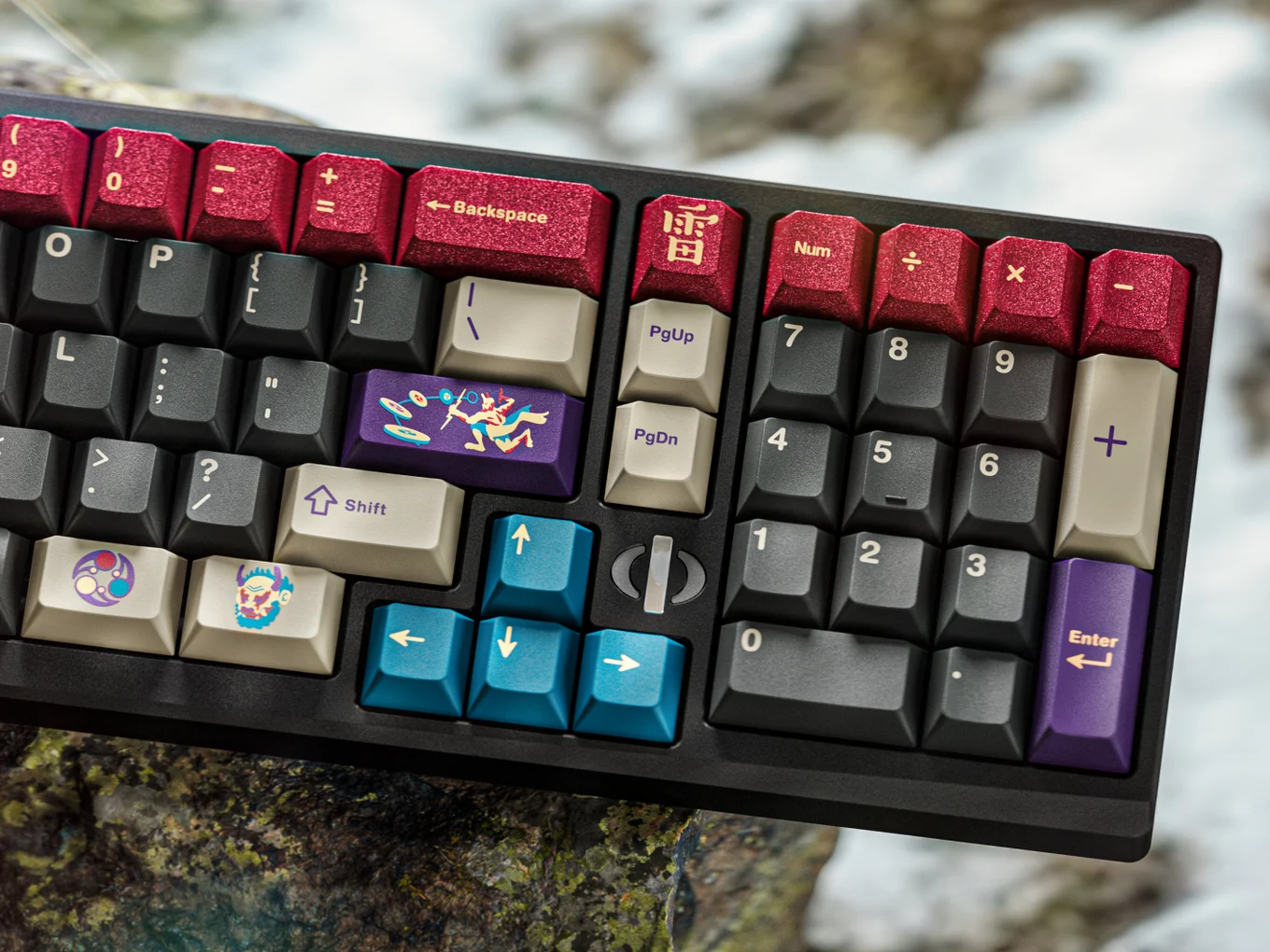
GMK CYL Thunder God, designed by rayhhdailo, gives the sparkle material a specific job. Its alert-style number row makes a band of accent color above the letters, and the sparkle treatment is particularly visible there. The number-row accents are in the Base. The separate Novelties kit buys different graphics, so buying just that add-on misses the feature if your goal is the glitter strip. The designer’s thread includes photographs of a physical GMK sparkle sample under several lighting conditions.
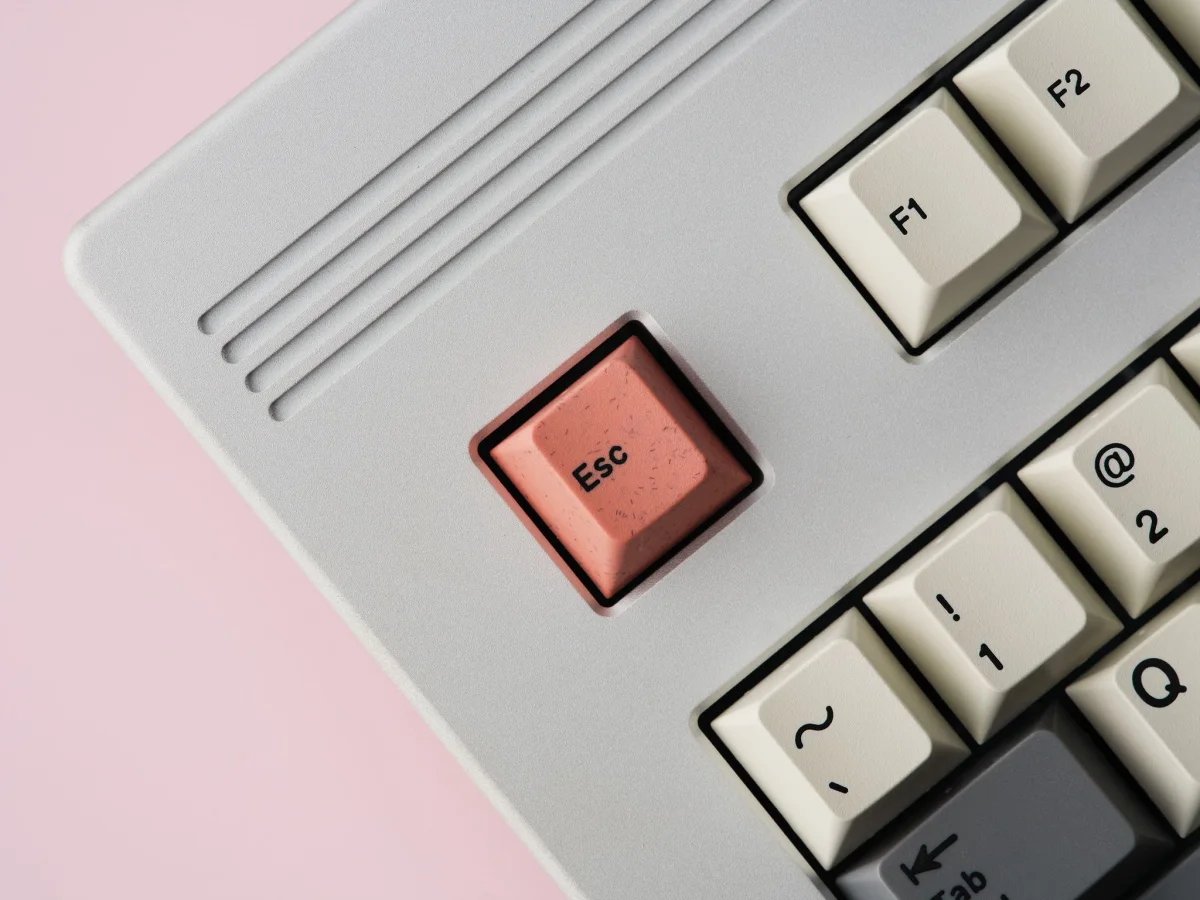
GMK’s CYL Flitter Effect Accent Kit takes the opposite approach to coverage. GMK lists five caps across Esc, Enter, and spacebar positions, with several color choices. An Esc accent is a simple way to see the material at your own desk. The longer keys make the effect more prominent if their sizes fit. For an ISO board, verify the Enter shape first. For a board with a 7u or split spacebar, inspect the bar in the kit instead of assuming every color option includes your size.
GMK groups particles and flitter among its special effects. In its design guide, speckled examples show contrasting particles against a light ground, while flitter examples use darker grounds to bring out the sparkle. These photos help distinguish the two looks, but the specific color and scale of the inclusions matter more than the category name. Glints that stand out in a close-up may barely register across a whole board under diffuse room lighting.
Streaking and what a physical sample can show
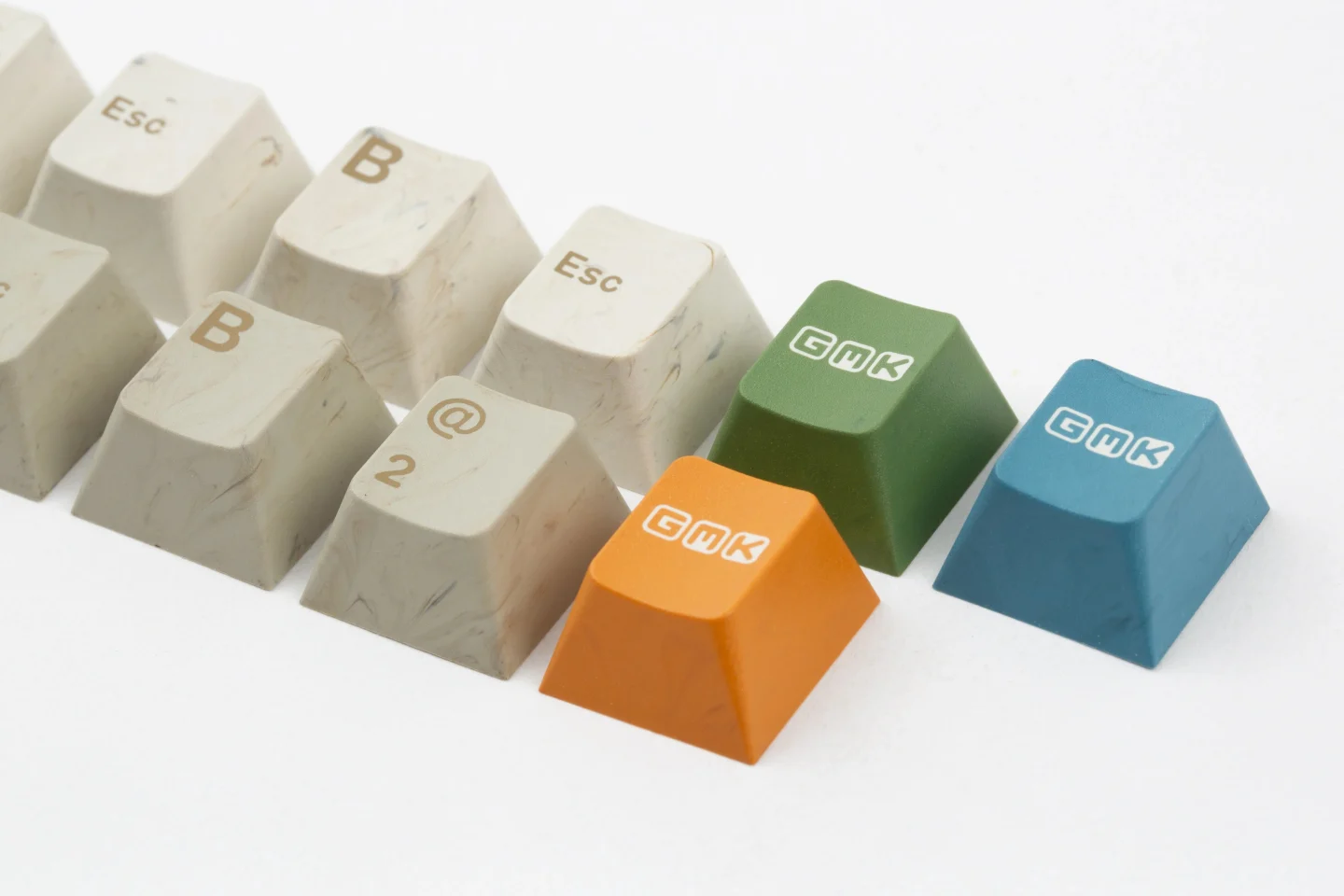
GMK’s streaking effect creates visible lines or swirls as the material flows in the mold. GMK offers several strengths for design projects. Beige Boogaloo shows how even a subdued, two-tone palette can use the effect. The physical samples on KBDfans show streaks in the beige material alongside solid accent colors. At a glance you may see neutral beige, while a close view shows variation in the surface pattern. Use the sample as evidence of the treatment and the final kit sheet to find where it belongs.
A straight-on photo under diffuse light tells you whether the legend is readable and how strongly the cap contrasts with its neighbors. A low-angle photo under a single light tells you how the appearance changes as the key catches a reflection. Ask for both angles on the same key, then look at a second key from the same batch if a uniform pattern matters. One bright photo can make a whole set seem sparkly even when the effect is subtle from a normal typing position.
If you are matching a case by a color code, check the effect version of the sample. GMK’s design guidelines note that a special-effect material may look different from the standard plastic with the same color designation. A physical swatch next to the case under your own lighting is a better reference than a color picker from the render. The GMK ABS CYL Special Effect Colors Kit is a way to inspect several treatments before choosing a full set. A finished set can still vary from one key to another.
4. What GMK CYL sounds and looks like in use
Listen to a keycap set on a complete keyboard and you are hearing the switches, the keycaps, the stabilizers, and the rest of the board together. The material is one part of that system. A short letter key and a stabilized spacebar can produce very different impacts on the same board even when both are made of the same plastic. Plate, mount, foam, desk surface, and how firmly you type all contribute to the sound you hear.
For a useful CYL comparison, play a run of letter keys and then listen to the long keys separately. On the letter keys, notice the initial impact, the return, and any texture between them. On the spacebar and Enter, listen for rattling, ringing, or a sharper hit from one side. A different stabilizer or wire setup can dominate there. The Keebpedia guide to keyboard switch sounds explains which parts of a recording correspond to different stages of a press.
To compare two sets on your own board, swap the same few key positions and keep the switches, plate, and microphone settings in place. Record the same phrase and a few isolated taps, with the microphone at the same angle and distance. Use the same playback level. A home recording made this way is useful for choosing a build. Comparing separately produced clips is still useful for identifying a sound you like, but the difference can come from how the video was recorded.
GMK CYL vs. Signature Plastics DCS
Signature Plastics DCS is a sculpted cylindrical profile. The DCS caps in this comparison have walls about 1 mm thick. Listen for a sharper, slappier impact on DCS. The switch’s own sound comes through more directly in this recording, especially on the letter keys.
GMK CYL vs. KeyKobo
The KeyKobo caps feel smoother under the fingertips than the GMK CYL caps in this comparison. In the recording, the KeyKobo keystrokes sound slightly more muted, as though a little of the sharp edge has been filtered out. KeyKobo is often the lower-priced option at NovelKeys. The retailer has listed Signet, Abyss, and Glacier at $110 each before discounts, while the GMK CYL Shinseiki base has listed at $125. Compare the keys each kit includes and the delivered price for your build.
How ABS shine differs from an intentional finish
A new textured cap scatters light across its surface. As the high spots of the texture wear down, frequently touched areas can develop a smooth sheen. Look at the thumb area of the spacebar, the Shift key you use most, and the letters your hands return to often. A shiny patch following your touch points is a different visual cue from metallic color through the legend or glitter distributed through the molded body.
When looking at a used set, compare a frequently used and a lightly used key of the same color under the same light. Choose matching row shapes where possible, since the top angles change the reflection. A close photograph of the whole keyboard can hide wear that is obvious when the spacebar is tilted toward a desk light. A smooth spot also changes how the cap feels under your fingertip, which matters more to some typists than the reflection.
Backlighting is another separate property. The standard CYL and MTNU White on Black listings specify no backlight support. The white legends are legible in ambient light, and a keyboard’s LEDs may still glow through gaps around the keys. If you depend on illuminated characters in a dark room, confirm the listing explicitly describes that function for your chosen kit and check where the legends sit relative to the LEDs.
5. Which GMK keycap kit fits your keyboard?
Start with the exact PCB layout you intend to build. A cap needs the right stem mount, width, and row shape. On keys with stabilizers, the posts also have to line up. A unit, written u, is the width of one ordinary letter-key position on the keyboard grid. Each drawing has its own visual scale, so compare the labels and relative widths. A bar labeled 7u occupies seven letter-key positions. A 6.25u bar occupies six and a quarter.
Separate physical fit from legend match. A 1u key with the correct sculpt can fill a small navigation position even if it says PgUp and you program it as Delete. A UK user can also assign a UK keymap independently of the printed caps. In both cases the key can work while the printed label disagrees with its output. Decide whether you are shopping for fit alone or want the keyboard labels to match your keymap exactly.
These examples use GMK’s own CYL White on Black kits. Another vendor’s White on Black kit, a different group-buy round, or White on Black in MTNU may use a different set of keys. Compare the board diagram and the selected kit sheet before ordering.
| Keyboard and layout | What to check | Kit to start with |
|---|---|---|
| Keychron Q2 ANSI, three-key navigation column | 1.75u right Shift, 6.25u spacebar, three 1u right-hand modifiers, row-matched navigation | 70% Base for physical coverage. Check printed navigation and Mac labels. |
| CannonKeys Brutal V2 1800, solder PCB built with 7u | 7u bar, modifiers either side, function row and numpad including the correct zero | Grand Base for these keys. Match the rest to the specific solder layout. |
| Keychron Q2 UK ISO, three-key navigation column | Tall Enter, short left Shift, extra key by Z, UK punctuation, 1.75u right Shift | 70% Base plus UK Kit. The UK Kit supplies the ISO-specific shapes and localized legends. |
These are layout and kit-diagram checks. Verify switch clearance and compare any custom key assignments separately.
Keychron Q2 ANSI: the short right Shift and navigation column
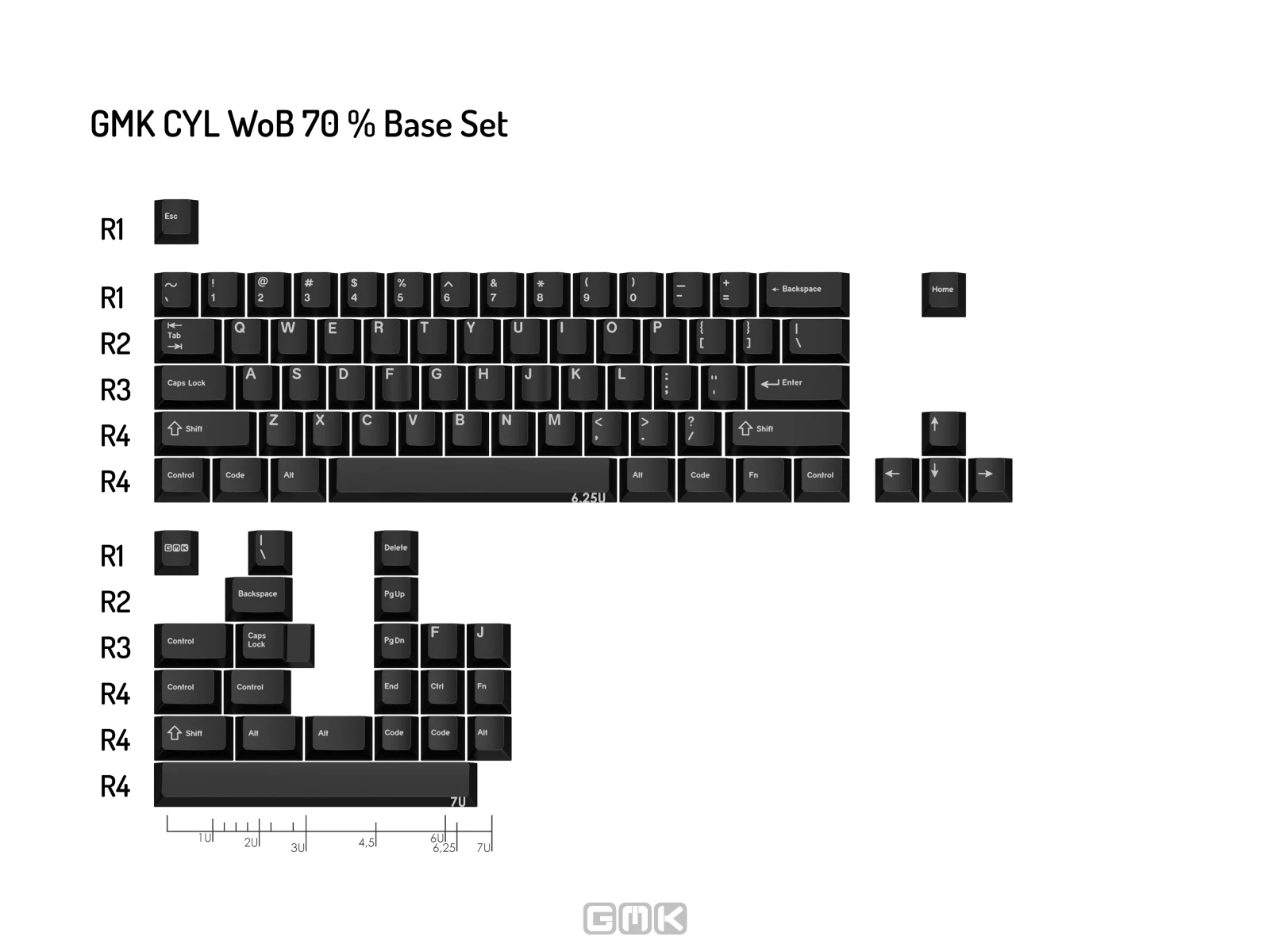
In the ANSI drawing in the Keychron Q2 keycap size chart, the right Shift is 1.75u to make room for the Up arrow, the bar is 6.25u, and the three positions immediately right of the bar take 1u keys. The WoB 70% Base sheet shows those widths, including three usable small modifiers. The larger Shift at the right end of the main block on the kit sheet is for another layout. Look in the extra rows of keys for the short one.
For the right-hand navigation column you can use the GMK keys in the relevant rows, for example R1 Delete, R2 PgUp, and R3 PgDn. This fills the three positions with the correct sculpt. The Q2 diagram shows Insert, Delete, and Home there, so those three substitute caps do not preserve the stock labels. For a clean legend match, remap those positions to the caps you install or choose a kit with the labels you want in the correct rows. Check the bottom row the same way if you want printed Command and Option instead of the supplied PC-style choices.
Brutal V2 1800: a 7u bar and a numpad in the same kit
CannonKeys specifies a 6.25u spacebar stabilizer for the hot-swap Brutal V2 1800. The solder PCB supports a 6.25u or 7u configuration, depending on the layout you build. For the 7u version, mark the width of each modifier on either side of the bar before opening the kit diagram. The wider spacebar changes the room for adjacent keys, so a spare 7u bar by itself solves only one part of the bottom row.
GMK explicitly includes 7u 1800 coverage in the WoB Grand Base description. Its diagram shows both spacebar widths, extra bottom-row modifiers, a function row, and a numpad with compact options including a 1u zero. The 70% diagram actually has a 7u bar as well, but it lacks the function row and the numpad. For this build, that makes Grand Base a better starting point for one purchase. If reusing a smaller kit, check the extra numpad and function keys individually before ordering a second set.
The board still has multiple possible solder layouts. If you chose split Backspace, an alternative Caps Lock, or a different Shift configuration, trace those positions in the board diagram and find each cap in the kit. The same process works on an otherwise standard-looking tenkeyless board, where the outside case gives little clue to the width of the bar.
Keychron Q2 UK ISO: enter shape and punctuation are separate checks
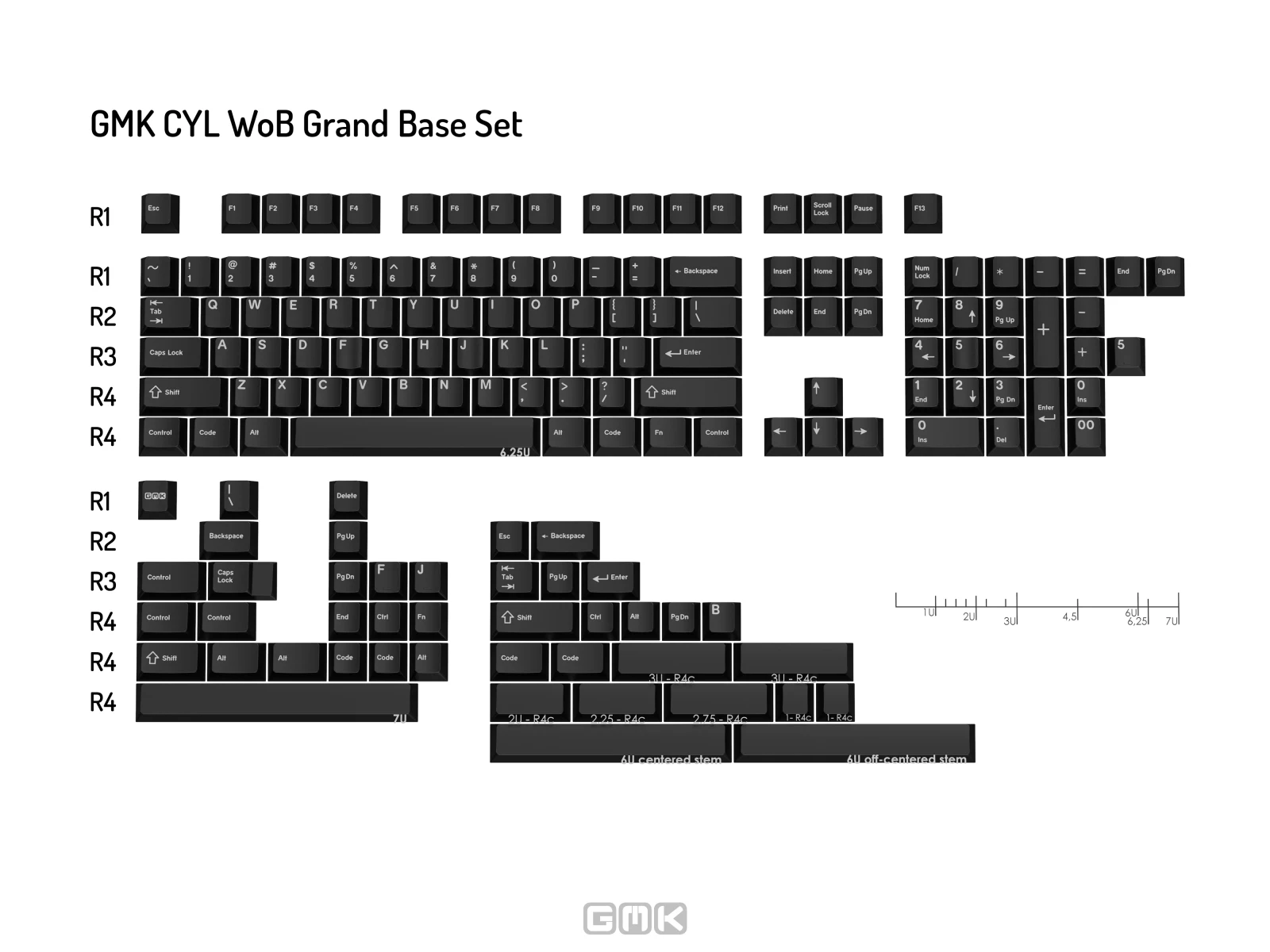
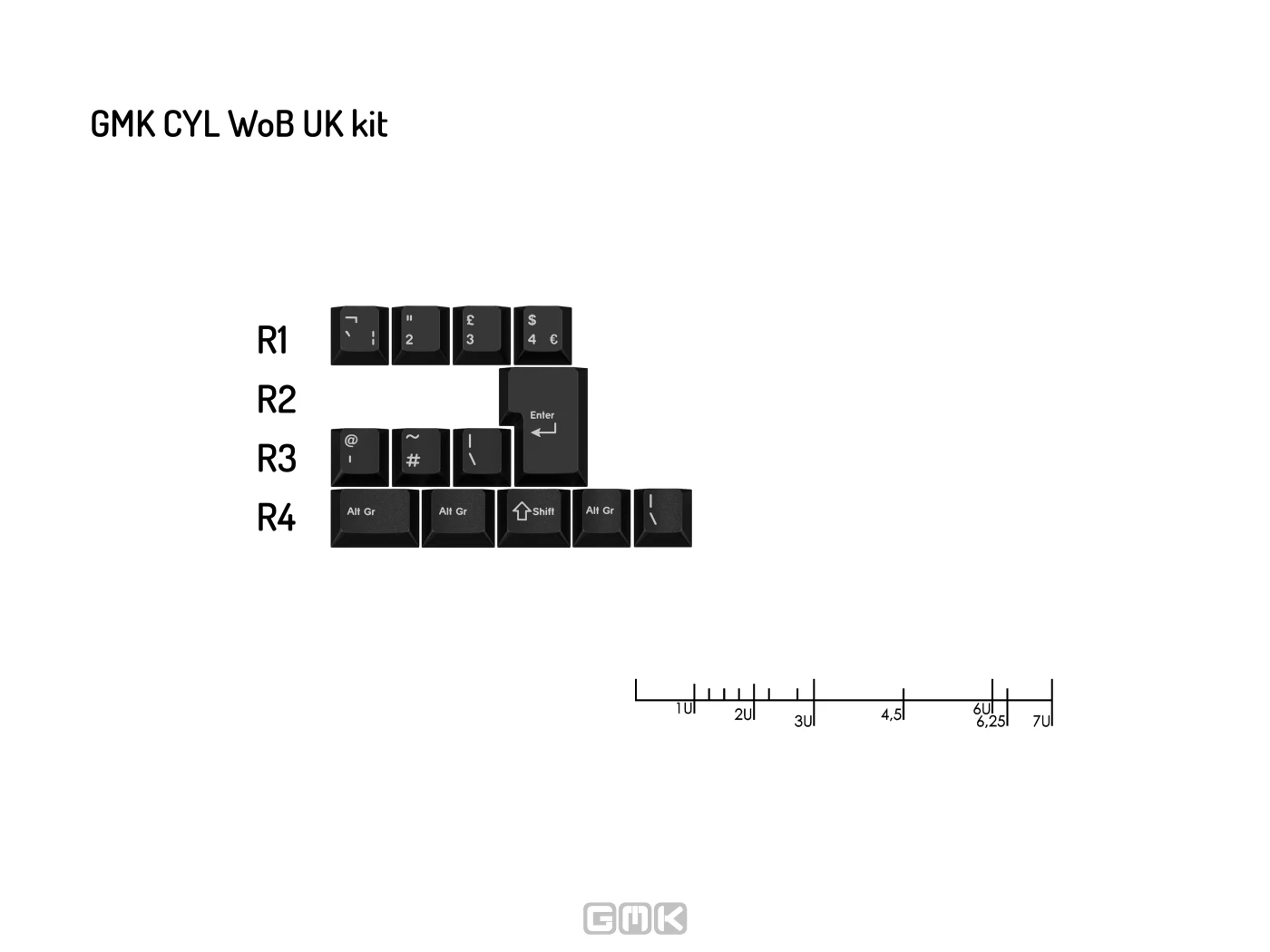
The UK diagram in the Keychron Q2 keycap size chart changes the outline of Enter and shortens left Shift to make space for the extra key by Z. It also keeps the compact right Shift and the small modifiers found on the ANSI version. GMK’s CYL WoB UK Kit shows the tall Enter and short left Shift together with the matching punctuation. Pair it with the compact base so the other keys on the board are covered.
An ISO-capable kit can come with the tall Enter and the short Shift but only a few keys that cover the extra positions. This is sometimes described as terminal ISO coverage in kit notes. For everyday UK labels, compare 2 and its quotation mark, 3 and its pound sign, the apostrophe and at sign, and the hash and backslash positions. Look for Alt Gr in the width you need if you use that legend. The UK add-on contains only the keys that differ, so it needs a base to supply the rest of the board.
This distinction also helps when a seller lists an international option as NorDeUK. Read the actual picture for that run. A language kit can cover several regional layouts, but the base beside it still determines spacebar, modifier, and navigation coverage. An attractive add-on does little for a build if the one base compatible with it is unavailable.
Check switch clearance as well as layout
Most ordinary MX-style switches accept the cross mount used by these GMK keycaps. GMK bases its fit tolerances on genuine Cherry MX switches, so check the actual switch if you use another stem or an unusual housing. Low-profile keyboards can have different stem mounts or have too little clearance for standard caps, even where the top of the switch looks familiar.
On some north-facing switch combinations, a low Cherry-profile key touches the switch housing as you press. Fit a cap to the suspect position and press it slowly in the center and at the edge. If it stops earlier or hits differently from a suitable comparison, try the exact cap and switch combination before buying a full set. A short test across several rows catches problems a single Esc key might miss. For long keys, check that the stabilizer mounts align and the cap returns freely after a press at either end.
6. Why are GMK keycaps expensive?
GMK’s custom-set FAQ lists the number and sizes of keys, standard versus custom colors, new legend or novelty tooling, and order quantity among its quote factors. A design with many special widths and artwork adds different requirements from a stock white-on-black kit using familiar keys. The number of caps in a box is only one part of the comparison. A key with a new molded icon and a key with an established letter use different production work.
Minimums also affect how designers split a project. In its custom quote guidance, GMK gives 150 sets for standard colors and 250 for custom colors, with separate qualifications for custom-color projects. That is guidance for commissioned runs. Read the terms of the particular listing if a vendor calls a run a small batch, preorder, or group buy. A regional seller may offer only part of the original kit selection, or a novelty kit may be available after the matching base has sold through.
Start with the cost to cover one board. A small kit can be better value if it fits all your positions. A larger base can cost less than a compact kit plus several extensions, particularly when you want to reuse it on a second board. Separate the pieces you need from decoration you would like. Someone using ANSI may value the spare bar in a Grand Base, while someone using UK ISO may get more use from the language kit. Per-key price misses both use cases.
GMK’s storefront provides a clean example within one CYL colorway. Its 70% Base was €89, its Grand Base €139, and its UK Kit €19 in the storefront checked on November 14, 2026. The numbers below come from selecting those exact kits. A starting price for a colorway can belong to a small accessory, which is why comparing the first number in two search results often produces a misleading result.
| Build | Cart contents | Keycap subtotal |
|---|---|---|
| Q2 ANSI, compatible substitute legends | 70% Base | €89 |
| Q2 UK ISO | 70% Base + UK Kit | €108 |
| 7u 1800 with a numpad | Grand Base | €139 |
Listed prices included VAT in the storefront checked. Shipping and any destination-specific charges are extra. Figures illustrate kit selection and can change.
Compare the price of the build you will actually type on
For a special finish, find the smallest purchase that delivers the effect you want. The Thunder God Base already supplies the sparkle number row. Black & Gold’s Base supplies metallic legends, while the novelty and accent spacebar kits change which positions display the gold. If a few colored keys are enough, a compatible Flitter Effect Accent Kit may give an existing CYL board the detail you want without replacing the entire set.
When deciding between two stores, put the same kit and add-ons into each cart before comparing. Look at the delivery currency, taxes, and shipping, especially when the compatible language or spacebar kit comes from a separate seller. A low base price can disappear into a second parcel. If a split shipment brings the base months before an essential add-on, consider what keys you will have available while you wait.
For a basic colorway, compare the other kit you would realistically buy. A well-kitted Cherry-profile set may give you the shape, readable legends, and every width you need at a lower total. GMK’s value is easier to judge if you can name what you would miss on that particular alternative, such as the metallic legends, the exact color match, the spherical MTNU shape, or the way the set handles a less common layout.
7. Where to buy GMK keycaps
Start with GMK’s own shop or GMK’s dealer directory. It lists NovelKeys, CannonKeys, and Omnitype in North America, Oblotzky Industries and Proto[Typist] in Europe, and GEONWORKS, zFrontier, KLC, KBDfans, and Swagkeys among options in Asia. Check the project’s own vendor list for the exact run. A store authorized to sell GMK may carry a different round, a subset of kits, or none of that colorway.
Names in search results can be misleading. GMK specifically names gmkkeycaps.com, gmkkeycap.com, and gmk-keycap.com in its dealer directory as sites that do not sell its products and are outside its official partner network. Use the manufacturer’s directory to get to the storefront, especially if a search for a popular colorway lands on a site that uses GMK in its domain. For a themed set, the original designer’s project page is also useful for tying the listing to a vendor and production round.
| Listing | What you are buying | What to verify first |
|---|---|---|
| In stock | A kit held by the retailer | Stock for your selected variant and the dispatch estimate. |
| Extras | Additional stock from a production run | Exact round, condition, and whether remaining base and add-ons can be bought together. |
| Group buy or preorder | A commitment for a future batch or shipment | Expected milestone, vendor updates, and order-change or cancellation terms. |
| Secondhand | A set already purchased by someone else | Exact kits, actual contents, signs of wear, and seller provenance. |
Read the batch status and inspect secondhand kits
A group buy collects orders during a window and delivery can depend on later manufacturing and shipping. A preorder can describe an incoming batch already ordered by the vendor, or it can appear on a page where production is still ahead. Read the store’s terms and look for the most recent update that names your batch. A completed color sample, production completion, arrival at the vendor, and dispatch to customers are different milestones. Our GMK group buy guide shows how to join a group buy and track your order.
Extras are usually a simpler option if the retailer already holds the stock and has your exact kit. Check the options menu for words such as Base, Extension, and Novelties after a search takes you directly to the product page. A listing can remain visible with just a few accessories left. If the page still carries an old group-buy banner, check the cart variant, current availability, and the seller’s description before working out a delivery date.
A secondhand listing needs photos of the actual kit, ideally laid out by row or shown in a tray with the extras visible. Check the exact round, look for the alternate spacebar and modifiers you need, and compare the seller’s photograph against the official diagram. Ask for a view of the underside of a long key if you are checking the stems or stabilizer mounts. A box label or order receipt helps establish provenance. The keys themselves tell you whether the cap you need is actually included.
Tell the seller which keys matter to your build if you are buying a partial kit. A missing 7u bar may be irrelevant to the previous owner and decisive to you. For used ABS, ask for a low-angle shot of the spacebar and frequent letter keys. For effects, ask for an ordinary light photo and a close view of a few neighboring caps. The difference between two factory flow patterns looks very different from a polished patch where a thumb repeatedly hit the spacebar.
If both the base and a hard-to-find add-on must arrive for a build to work, secure the compatible options together where possible. Buying the novelty first is fine if you only want a few decorative caps for an existing set. For a full layout, the base and the uncommon physical keys determine whether the purchase is complete. Check that the colorway, finish, and profile agree across separately listed kits before assuming they will match.
8. Are GMK keycaps worth it for your build?
GMK CYL makes sense when you like the cylindrical Cherry-profile feel and the kit provides something you can point to on the board. That might be the gold on the Black & Gold legends, the texture in a Mechakaiju key face, or how the Thunder God number row sits above the letters. For a plain colorway, the right purchase might simply be the smaller kit that already includes your unusual Shift and spacebar.
MTNU makes sense when the medium-height spherical tops and doubleshot PBT are what you want to type on every day. Use the same layout audit as you would for CYL and look at how the homing keys and row angles work for your fingers. A photograph of a colorway in another profile can help choose the palette, but the same palette will not tell you how the cap feels.
Before checkout, identify the exact keyboard layout, mark the nonstandard keys, and write down which kit supplies each of them. For a special finish, find a physical sample and check the parts you will install. Compare the resulting cart total and delivery terms with your next choice. A set is easiest to justify when you can see where the extra cost goes and you would choose the same shape and finish without the GMK name in the listing.