GravaStar Mercury V60 Review: Clear Looks, Clean Sound, Firm Feel
The Onyx Crystal’s sculpted case gets your attention, but its consistent sound and firm keypress make the stronger case for keeping it on your desk. We tried the Mercury V60 with its stock UFO magnetic switches.
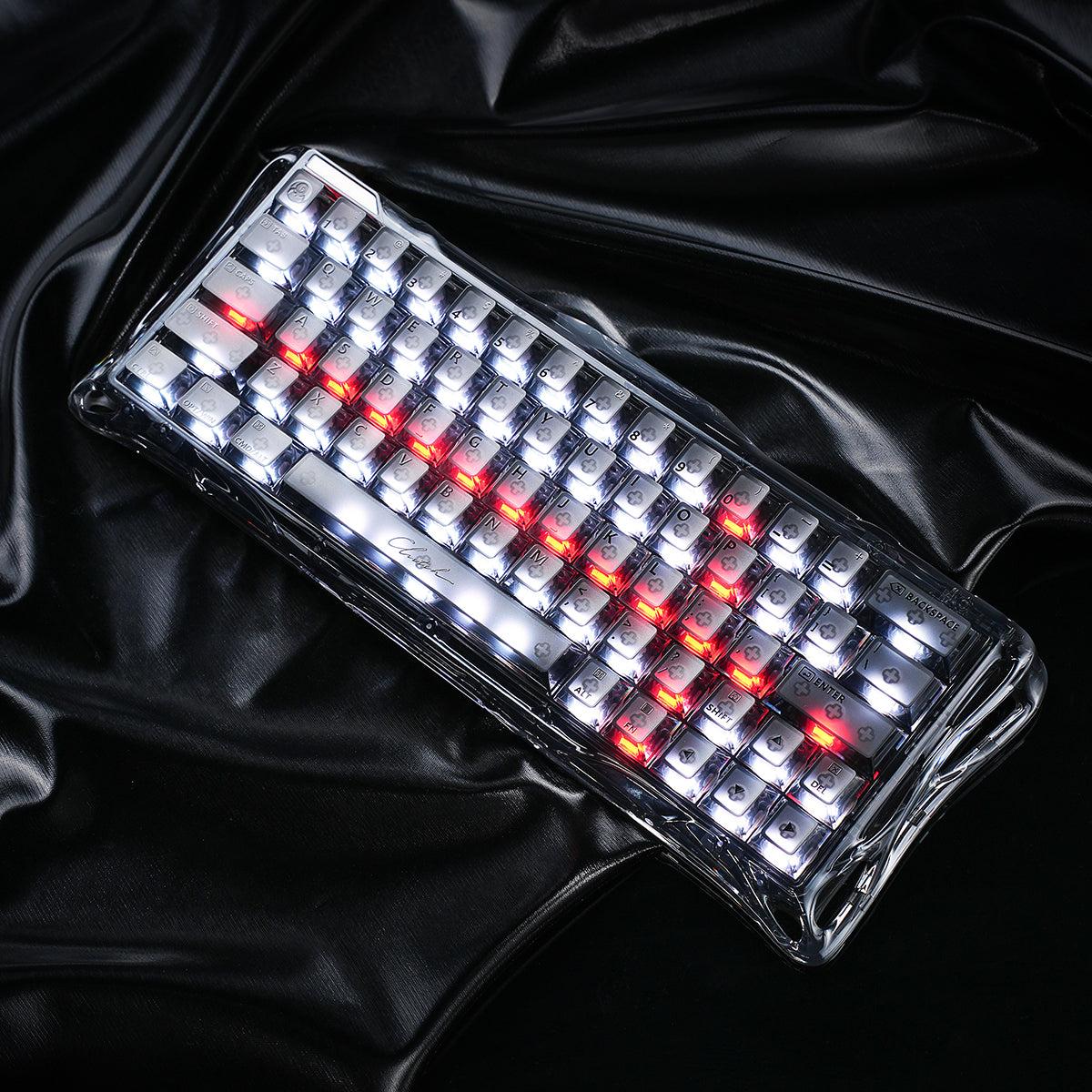
What is the GravaStar Mercury V60?
The Mercury V60 is a compact wired Hall Effect keyboard. The Onyx Crystal version pairs a smoky transparent case with translucent keycaps and GravaStar UFO magnetic switches. It has dedicated arrow keys despite its 60% footprint, with a shortened right Shift making room for the cluster.
GravaStar supplied the keyboard for my original review. My interest here is the typing experience: how the keys sound, how the plate feels beneath them, and whether the design works as a complete keyboard. Competitive gaming and detailed driver testing were outside that review’s scope.
The result impressed me. The design, sound and keypress felt carefully matched, and I enjoyed using it enough to consider keeping it as a reference board for future Hall Effect switch reviews.
| Feature | Details |
|---|---|
| Layout | Compact 60% footprint with dedicated arrows; US ANSI review unit |
| Connection | Wired USB-C |
| Case | Polycarbonate, as identified in the original review |
| Mount / plate | Top mount / aluminum |
| Switches | GravaStar UFO magnetic switches |
| Damping | All stock foam installed; GravaStar advertises five acoustic layers |
| Measured weight | Approximately 711–712 g, keyboard only |
| Measured front edge | Approximately 18.8 mm |
Measurements come from the original review unit, not a manufacturer tolerance specification. The official storefront’s 1.67 kg figure includes packaging.
A transparent case with a distinct shape
The case does more than put lights inside a rectangle. Its curved edges, raised details and sculpted side profile give it the futuristic appearance I associate with GravaStar. I especially liked the shape from the side: it has a more deliberate outline than a plain box with RGB added.
Light comes through the smoky case and translucent caps. In the review, I also noticed several light points beneath the spacebar, rather than illumination concentrated in one spot. Together, these details make the lighting part of the appearance of the whole board.
At roughly 711–712 g on my scale, the keyboard was easy to pick up and move. The front edge measured about 18.8 mm, though its curved shape makes that an approximate measurement. These are observations of this plastic-cased Onyx Crystal unit; they should not be applied to the aluminum V60 Pro or Ultra.
Listen: a stock sound that stays consistent
What stood out was how well the sound held together across the keyboard. The spacebar did not produce the hollow, booming note I sometimes hear on Hall Effect boards, and the keys around the edges did not introduce distracting noises. I liked the consistency as much as the sound of any individual key.
There is still a plastic character to the case’s sound. To my ears, it was controlled and pleasant rather than an objectionable resonance. The installed damping may contribute to that result, but I did not record a controlled foam-in/foam-out comparison, so I cannot assign the effect to one particular layer.
The clip below is Keebpedia’s dedicated recording with stock keycaps, UFO magnetic switches and all foam installed. It starts at the beginning of the 41-second video. Listen to the spacebar and the outer keys as well as the main letter area when deciding whether you like the overall sound.
Firm, without an unpleasantly hard landing
The Mercury V60 uses a top-mounted plate, and the plate on my unit was aluminum. In the review I pointed out the mounting screws securing the plate to the top case, separate from the screws joining the case halves. That construction helps explain the firm feel under the fingers.
It was firmer than a flexible gasket-mounted keyboard with a polycarbonate plate, but I did not find it painfully hard. There was enough comfort for me to enjoy typing while retaining a definite end to each stroke. If you like a stable keypress, this combination is one of the keyboard’s strengths.
The UFO switches were described in the original review as roughly 50 gf at bottom-out. I did not measure a force curve, so treat that as the review’s reference figure rather than a verified specification for every UFO revision. What mattered in use was that the resistance felt comfortable alongside the firm plate.
Arrows are welcome; the keycaps will divide opinion
Having arrow keys on a board this small was a welcome surprise. I already use similar arrow positions on some of my own compact keyboards, so the arrangement made sense to me immediately. It gives this layout more everyday usefulness than a compact board that puts every arrow behind a function layer.
The tradeoff is the short right Shift. The review unit also keeps a normal Backspace rather than a split arrangement. Check the physical layout before choosing replacement keycaps; matching the MX-style cross stem alone does not guarantee that every key in a set will fit.
The stock keycaps are translucent and their legends have a texture you can feel. I suspected UV printing during the review, but did not verify the printing process. I measured a cap wall at around 1.4 mm. The raised decoration, including the large spacebar graphic, did not bother me personally, though readers who prefer an untextured surface may feel differently.
Gaming features need a separate test
GravaStar advertises 8,000 Hz USB polling, adjustable actuation and Rapid Trigger, and provides a browser-based configuration tool. A physical selector on the review unit switched between four profiles, with a different indicator color for each. That is a useful way to move between saved setups.
I did not test the web driver in depth or measure latency, actuation accuracy or Rapid Trigger consistency. A polling-rate specification is not an independently measured end-to-end response time. My positive assessment of the sound and construction should therefore be read separately from a judgment about competitive performance.
The switches are hot-swappable, but this is a magnetic keyboard. Do not assume that a conventional MX mechanical switch, or any magnetic switch with a similar shape, will work. Check the exact model’s compatibility before buying replacements.
Verdict
The Onyx Crystal won me over through the way its parts work together. The case looks distinctive, the typing sound stays clean across the board, and the firm top-mounted feel suits the stock switches. I came away thinking this was a well-finished keyboard I would enjoy keeping on my desk.
At the time of the original review, the Japanese selling price was below ¥20,000, which felt reasonable for that experience. That is historical context rather than a current offer; check the product page below for the available configurations and purchase links.
I would put it on the shortlist for someone who wants a compact wired Hall Effect board with arrow keys and enjoys a firm typing feel. The plastic case’s sound, textured legends and small right Shift are the main preference checks. For competitive gaming, the unanswered firmware and performance questions still need their own evaluation.
GravaStar Mercury V60 · Onyx CrystalSee the reviewed configuration, specifications and available stores on Keebpedia.